Bioethics and Grief Technologies: Metropolis, by Fritz Lang (1927)
byUniversidad de Buenos Aires, Argentina
Swinburne University of Technology, Australia
Cinema is gearing up for one of its most significant anniversaries. 2027 will mark the 100th anniversary of the premiere of Fritz Lang’s Metropolis, an iconic science fiction film based on the novel of the same name by Thea von Harbou and set in the year 2026! As is well known, the film is a marvel of German Expressionism that visually captures the treatment of bodies in the industrial age. Its release coincided with the first appearance of the term “bioethics”, with the publication that same year of Fritz Jahr’s pioneering article, "A Perspective on the Ethical Relationship of Human Beings with Animals and Plants." [1]
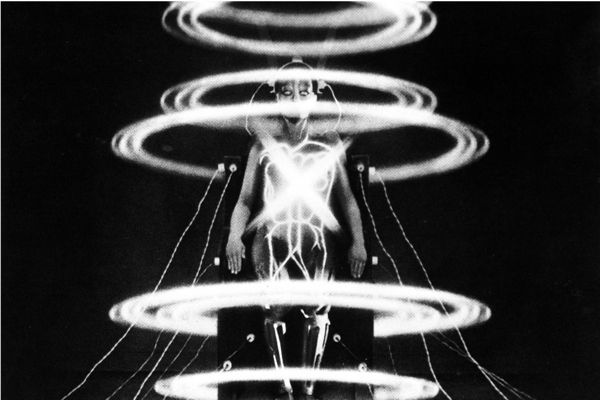
The fallen bodies of workers and the legion of those who will replace them in the production chain are among the most moving and remembered images in cinema, as well as the famous Maschinenmensch, one of the greatest icons of the seventh art.
The film, whose complete reconstruction was made possible by a discovery two decades ago in Buenos Aires, has been interpreted in many ways and has been the subject of countless articles. In previous editions of Ethics & Cinema, we have addressed some of the biopolitical issues raised by the film. For this review, we will take a different approach, since Metropolis can be seen as a visionary warning regarding the use of androids and robotic technology for processing grief. Although not explicitly named as such, the plot anticipates by a hundred years one of the most unsettling uses of generative artificial intelligence: programs marketed as grief technology. These are systems that process digital remains (photographs, videos, audios, messages, social networks) to recreate avatars, bots or androids that simulate the personality and voice of the deceased loved one.
In Metropolis, John Fredersen, the supreme leader and ruler of the city, was married to Hel, a beautiful woman who dies giving birth to their son. But before becoming Fredersen’s wife, Hel had been the partner of the scientist and inventor, Rotwang, who remained in love with her. To immortalize her, Rotwang, as brilliant as he was delusional, creates a giant monument in her honor and builds a robot woman in her likeness. This is the genesis of the most memorable android in cinema.
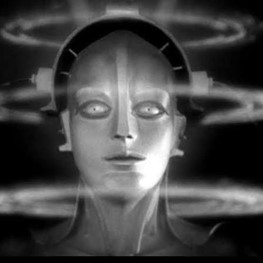
Thus, through his sinister invention, Rotwang privately worships Hel’s memory, forbidding Fredersen access to both the mausoleum and the android. In this way, he seeks revenge on his adversary while simultaneously denying the death of his loved one, researching ways to bring the android to life with Hel’s spirit and emotional intelligence. But the film’s plot holds surprises and the tragic end of this artificial creation serves as a warning against the futility of replacing the complex work of mourning with technology.
A century later, platforms like Seance AI and You, Only Virtual, use neural networks to create conversational replicas. These avatars mimic the communication style of the deceased, allowing their loved ones to interact with them via text, voice, or video. One of the most widely known projects is Dadbot, created by American technology researcher, writer, and journalist, James Vlahos, in 2016. This experiment, dubbed "digital immunity," aims to preserve the memory of his father, John, who was diagnosed with terminal cancer. The system was based on the collection of oral histories and real voice recordings of his father, allowing for the simulation of his speech patterns and personality traits.
Building on his personal project, Vlahos co-founded HereAfter AI, a company that offers similar services allowing people to converse with virtual recreations of their relatives using voice recordings. In China, there are already “digital resurrection” projects based on development of technology to synchronize lip movements with voice recordings, thus giving rise to the proliferation of highly personalized "grief robots", which are offered to family members as an aid to achieve closure or maintain ways of connecting with the deceased person.
Metropolis was set precisely in 2026, and today humanity is witnessing this proliferation of Rotwang ’s imitators, who, in the name of science, seek to suppress the reality of death. Cinema, however, has continued to offer clues regarding these risks. From Steven Spielberg’s classic "AI" (2001) to Lucía Puenzo’s recent "Futuro Desierto" (2026), we have been grappling with this issue for a quarter of the new century.
The plot lines tend to be repetitive, but always add nuance to the issue. The South Korean film, Wonderland (Kim Tae- yong, 2024), fictionalizes an artificial intelligence service that allows users to make video calls and reconnect with simulated replicas of their deceased loved ones. Or the Japanese film Sheep in the Box (Hirokazu) Koreeda (2026), which follows a couple who, after the loss of a child, agree to adopt an android designed by artificial intelligence using the deceased child’s fingerprints. And, of course, the memorable Black Mirror episode "Be Right Back," in which, after the death of her boyfriend, a woman uses a new online service that processes all her digital information to reconstruct his personality, going from text messages to a physical replica with his exact appearance.
Marjorie Prime (Michael Almereyda, 2017) deserves special mention. It’s a film adaptation of the play, which was nominated for the Pulitzer Prize for Drama in 2015 and premiered on Broadway in 2025. Set in the near future, the story follows an elderly woman with dementia who interacts with a "Prime," an interactive AI hologram programmed to resemble her late husband in his youth. Through this interaction, the woman attempts to reconstruct the memories she is gradually losing.
The death of a loved one demands symbolic work to process the void and avoid succumbing to melancholy or manic denial. Freud warned that love and hate coexist in mourning, and that this ambivalence generates profound guilt. In Metropolis, Rotwang’s entire strategy is geared towards denying grief. The inventor takes refuge in the imaginary to reject castration as real. His ambivalence towards Hel will later manifest itself when, in giving her life, he does so by embodying an evil version of Maria. Instead of the idealized and pure vision, he presents her as a manipulative and cruel harlot. When the flames devour the disguise of the false Maria, the ominous nature of his invention will be revealed. Thus, his false mourning, anchored in guilt and resentment, will be exposed.
NOTE
[1] About Fritz Jahr and narrative bioethics see Natacha Salomé Lima and Juan Jorge Michel Fariña “Fritz Jahr’s bioethical concept: an approach from aesthetics”. JAHR, Vol.2 Nro. 14, 2011. Available at: https://ojs.srce.hr/jahr/article/view/15818/8331
FORUM
Film:Metropolis
Original Title:Metropolis
Director: Fritz Lang
Year: 1927
Country: Alemania
Other comments by the author: