“It’s alive”: Bioethical Interest of the Myth
by ,University of Buenos Aires, Argentina and Swinburne University of Technology, Australia
“If man finally conquers death, will he not also die with it, his enemy? (…) neither the gods nor Paradise exist in and of themselves, they are, and always have been, part of the human story”
Jesús Alonso Burgos, Theory and History of Artificial Man
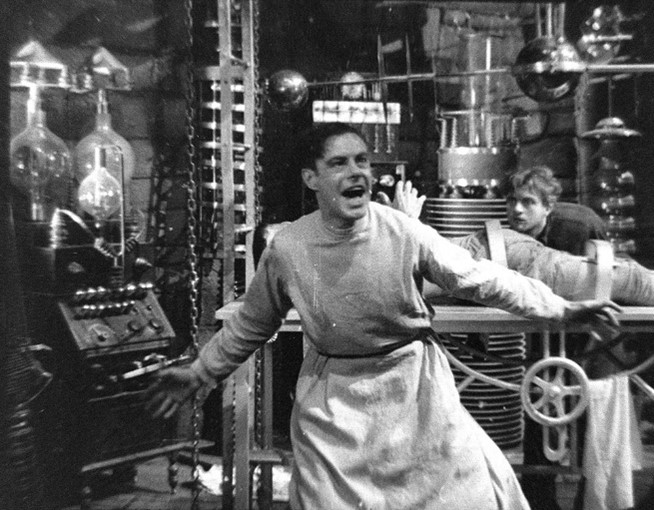
Perhaps one of the most memorable lines in film history is the scream of Dr. Frankenstein, portrayed by actor Colin Clive in the first sound film adaptation of Frankenstein. Upon discovering that he had succeeded in bringing his creature to life, he screams, gripped by a state of manic madness, “It’s alive.” The scream, absent in Mary Shelley’s gothic novel, would be repeated in several subsequent film adaptations of the story, despite its absence in the original text.
English distinguishes three pronouns: he, she, and it, typically reserving the third to refer to things that are not human. Thus, the doctor’s first reference to his creature as an “it” denotes that he considers his creation a thing, albeit an “it” that lives. The phrase has been translated into Romance languages as “está vivo” leaving the subject implicit. But the doctor does not say he is alive, but rather (it) is alive.
Dr. Frankenstein conceives of himself as a creator of human life, but not as a father. Why does he undertake the arduous task of assembling a man from parts of corpses, instead of following the simpler and more direct path of resurrecting a dead person? Because that would be to return to life a human being who once lived. Someone with a name, conceived by parents, born from a mother’s womb, likely desired, loved, named, and raised. Someone who formed an identity in connection with the first Others, which for new life would usually be these parental figures. Resurrecting him through science would be a reparative act, restoring life to a subject who already existed. But that is not what Dr. Frankenstein seeks. He does not want to be merely a repairer, a healer, a doctor who brings someone back to life.
A child of the Enlightenment, he intends to be a creator of human life. To demonstrate that one can be God through science, engaging in the transgressive act of anthropoeia. So, it’s not about resurrecting pre-existing life or achieving a form of immortality through traditional procreation but about creating a new man from the body parts of the dead and then breathing life into him. Two hundred years later, Frankenstein’s grandchildren aim to achieve this feat, without needing to rummage through cemeteries: now they can delve into DNA and attempt to clone a living being.
There is something enigmatic about Dr. Frankenstein’s experiment: it doesn’t aim to cure or repair. It’s about conquering death, about creating life through technology. A path that denies the castration that permeates us as sexual and finite humans. It’s not about creating life from life, following the common paths of sexual reproduction, which involves desire and sexual difference, but rather from death, through the laboratory, circumventing the difference between the sexes, the sexual relationship, and filial desire, driven by the drive to know. The enigma of the ultimate meaning of choosing such a path to produce a being returns to the creator in the form of a question from the creature to the doctor: “Why did you create me?” And it returns to him first and foremost as vertigo, anguish, and rejection of the product of his act, precisely at the point where he succeeds in going “beyond the father,” believing he has managed to emulate God and contemplate his finished product.
In the novel, Victor Frankenstein confesses:
“It was already one in the morning; the rain pattered dismally against the panes, and my candle was nearly burnt out, when, by the glimmer of the half-extinguished light, I saw the dull yellow eye of the creature open; it breathed hard, and a convulsive motion agitated its limbs.
How can I describe my emotions at this catastrophe, or how delineate the wretch whom with such infinite pains and care I had endeavoured to form? His limbs were in proportion, and I had selected his features as beautiful. Beautiful!– Great God! His yellow skin scarcely covered the work of muscles and arteries beneath; his hair was of a lustrous black, and flowing; his teeth of a pearly whiteness; but these luxuriances only formed a more horrid contrast with his watery eyes, that seemed almost of the same colour as the dun white sockets in which they were set, his shrivelled complexion and straight black lips.
The different accidents of life are not so changeable as the feelings of human nature. I had worked hard for nearly two years, for the sole purpose of infusing life into an inanimate body. For this I had deprived myself of rest and health. I had desired it with an ardour that far exceeded moderation; but now that I had finished, the beauty of the dream vanished, and breathless horror and disgust filled my heart. Unable to endure the aspect of the being I had created, I rushed out of the room, and continued a long time traversing my bedchamber, unable to compose my mind to sleep”. [1]
Time and again, what recurs in the variations of this modern myth, Frankenstein, is that question from the created to the creator, seeking to understand what motivated Dr. Frankenstein’s actions. It is a question born of the desire of the Other, which, in these narratives, does not find its answer in love, with the catastrophic consequences that invariably appear in this myth, from the films of James Whale to the replicants in Ridley Scott’s Blade Runner. The question directed at the creator is, at its core, also a reproach: “Why did you create me... so badly?” That is to say, helpless, powerless, destined to get sick, grow old and die, driven by passions, with a capacity for understanding that, unlike other living beings, allows us to recognize our own limitations, throwing us into a state of permanent dissatisfaction, in constant misunderstandings and disagreements with others, blinded by passions, driven by immanent or transcendent illusions, running ceaselessly like Achilles after that tortoise called happiness, without being able to reach it.
The philosopher Hannah Arendt argues that “the human condition is such that pain and effort are not mere symptoms that can be suppressed without changing one’s life; rather, they are the ways in which life, along with the necessity to which it is bound, makes itself felt. For mortals, the ‘easy life of the gods’ would be a life without life.” [2] Structural castration is experienced as a curse when those who brought a subject into the world did not do so out of a desire for their child, thus not bestowing upon the child a phallic value. Entry into the phallic equation articulates a newborn into the field of the Other’s desire as a valuable object that illusorily comes to fill the maternal lack, being inscribed in a genealogical chain, named, and assigned a parentage. The living body of being is thus elevated to the dignity of a subject for Others who longed for it from before birth, by placing it in the status of a phallus: someone who is named according to the desire of the parents, and protected by the paternal law that prohibits incestuous relations, to provisionally come to occupy the place that Freud called “his majesty, the ‘baby’”, at least during the formative period of subjectivity.
The curse afflicting Dr. Frankenstein’s creature is that it is merely the product of an experiment to satisfy its creator’s scientific ambitions. There is no desire for parenthood, and thus he failed to construct a harmonious body. He was too concerned with whether life could be produced from parts of corpses to recognize that the amalgamation of supposedly “beautiful” characteristics would create a whole that would ultimately repulse him. The creature doesn’t even become a support for the Other’s gaze, which might reflect back to it, like a mirror, the illusion of a complete body. The gaze of its creator reflects back to the creature the reality of its stitched-together body. The creature is a “corpse morcelé”, a body made of stitched fragments of corpses, not a unified body, because the Other does not reflect a kind image back to him. His body seems more suited to being exhibited in a medical museum than being shared among fellow human beings. Because the doctor cannot see the beautiful image he sought in his creature. And the absence of the veil of beauty reveals the reality of a body made of fragments that, from the very project of their creation, are not integrated under the loving gaze of the other. In the novel, the creature’s ugliness is what provokes rejection in the doctor from the beginning. A rejection of what he created, and a rejection of the act of creating it. The image his creature presents awakens horror, dread, repugnance. It is a hybrid between living and dead. A living dead thing. [3]
There is a dimension of horror in Dr. Frankenstein’s gesture, because if humans can be created using technological means, the scientific achievement throws overboard any notion of transcendence. It is the horror of an inventive act linked to parricide. If Colin Clive’s Dr. Frankenstein adds to his triumphant cry, “Now I know what it must feel like to be God,” this manic moment lasts only a breath. For if an imperfect human being like him manages, through his artifice, to create human life like a modern Prometheus, then there is no God, no divine plan. From mania to melancholy is but a step. By creating his creature, he has undermined the existence of a transcendent Other.
Frankenstein’s curse is the one the doctor casts upon the creature born of his act, a malevolent pronouncement about the living being he has brought into existence. A technical pronouncement, devoid of any personal connection or humanization. To the point that he doesn’t name it. It is simply “it.” Later, he will call it a “monster,” but without a proper name. [4] It is the public who has assigned the doctor’s surname to his creature, linking it to him despite Victor’s refusal to acknowledge the monster’s parentage and thus establish a lineage. And when the creature asks for a mate, he will again refuse, because he doesn’t want it to have offspring, terrified of becoming the creator of a “race of devils.”
In 1974, Mel Brooks released one of cinema’s greatest comedies: Young Frankenstein. It draws on the series of films about Frankenstein’s monster that Hollywood produced during the 1930s, especially the first two starring Boris Karloff. In the film, Frederick, Dr. Frankenstein’s grandson, must return to his grandfather’s sinister castle, where he is tempted to recreate his failed experiment. When he finally manages to create a living being with diminished mental capacity and superhuman strength, he initially regrets his creation. But Mel Brooks introduces an unexpected twist: Frederick goes from fearing the monster to treating him like a son. He provides him with protection, an education, and presents him to society as a supposedly refined man who can even perform a musical number. Ultimately, to prevent his son from being killed, he decides to share his brain so that he can become even more refined. While the original films about the myth revolve around the curse of not being wanted, named, or acknowledged by the creator, Young Frankenstein corrects this ominous curse, presenting a demonstration of why a subject’s fate as human or monster is not so much determined by how they were brought into being (naturally or artificially), but rather by whether they were desired as a human being to be integrated into a line of descent, or, on the contrary, rejected as a remnant or object. It hinges on whether the first Others welcomed that living being as a loving object to illusorily fill their own deficiencies. [5]
The monster thus becomes a form of return to the realm of the symbolic rejected by its creator, who fails to assume the role of father. This return is deadly for both creator and creature. This is the spirit of the novel Mary Shelley envisioned: the cursed monster, in turn, curses and is cursed, ultimately ending up alongside its creator at the edge of the world, destroying itself. The creature’s questioning of its existence, directed at its creator, finds only a deadly backdrop, culminating in a murderous act. This is how Mary Shelley imagined it, and variations of the myth reiterate this ending, for example, as is seen at the end of the film, Blade Runner. There, the story revolves around the creation of synthetic life, the manufacture of human replicas by a technology corporation. These replicants also turn against the engineer, Tyrrell, their creator, questioning him about the reasons for their creation and why they were programmed with a brief lifespan of only four years.
The latest film version of the myth, directed by Guillermo del Toro in 2025, proposes a reconciliation between Dr. Frankenstein and his creature. It’s a forced ending, which raises the question of why the creature would forgive its creator, who always treated it like a beast. This twist introduces the problem of conditions, but also of limits, of what is forgivable. But that’s a story for another film!
NOTE
[1] Shelley, Mary, Frankenstein or the modern Prometheus, London, George Routledge and Sons, 1888, p. 77-78.
[2] Arendt, H.; The Human Condition (1993), Barcelona, Paidós, p. 129.
[3] “Let us suppose, moreover, that the creature given life by the virtue of knowledge had been marked by beauty and not by ugliness, and that instead of rejection it had been given flattery and favors: would not Frankenstein be the greatest man, the most venerated and beloved, that our world has ever seen?” Eduardo Wolovelsky, “Frankenstein. The Creature,” in Frankenstein, the Great Prophecy, Buenos Aires, Mochuelo Libros, 2020, p. 15.
[4] The word "monster" appears around 20-30 times in the novel to refer to the creature, depending on the edition. The term (from the Latin monstrum) is applied to any being that exhibits notable anomalies or deviations from its species. It is also used to describe someone who, due to their moral or physical deformity, provokes rejection.
[5] “The functions of the father and the mother are judged according to such a need. The mother’s: insofar as her care is marked by a particularized interest, even if by way of her own deficiencies. The father’s: insofar as his name is the vector of an incarnation of the Law in desire.” Lacan, Jacques, “Two Notes on the Child,” in Interventions and Texts 2, Buenos Aires, Manantial, 1993, pp. 56–57.
FORUM
Film:El doctor Frankenstein
Original Title:Frankenstein
Director: James Whale
Year: 1931
Country: Estados Unidos
Other comments by the author: